
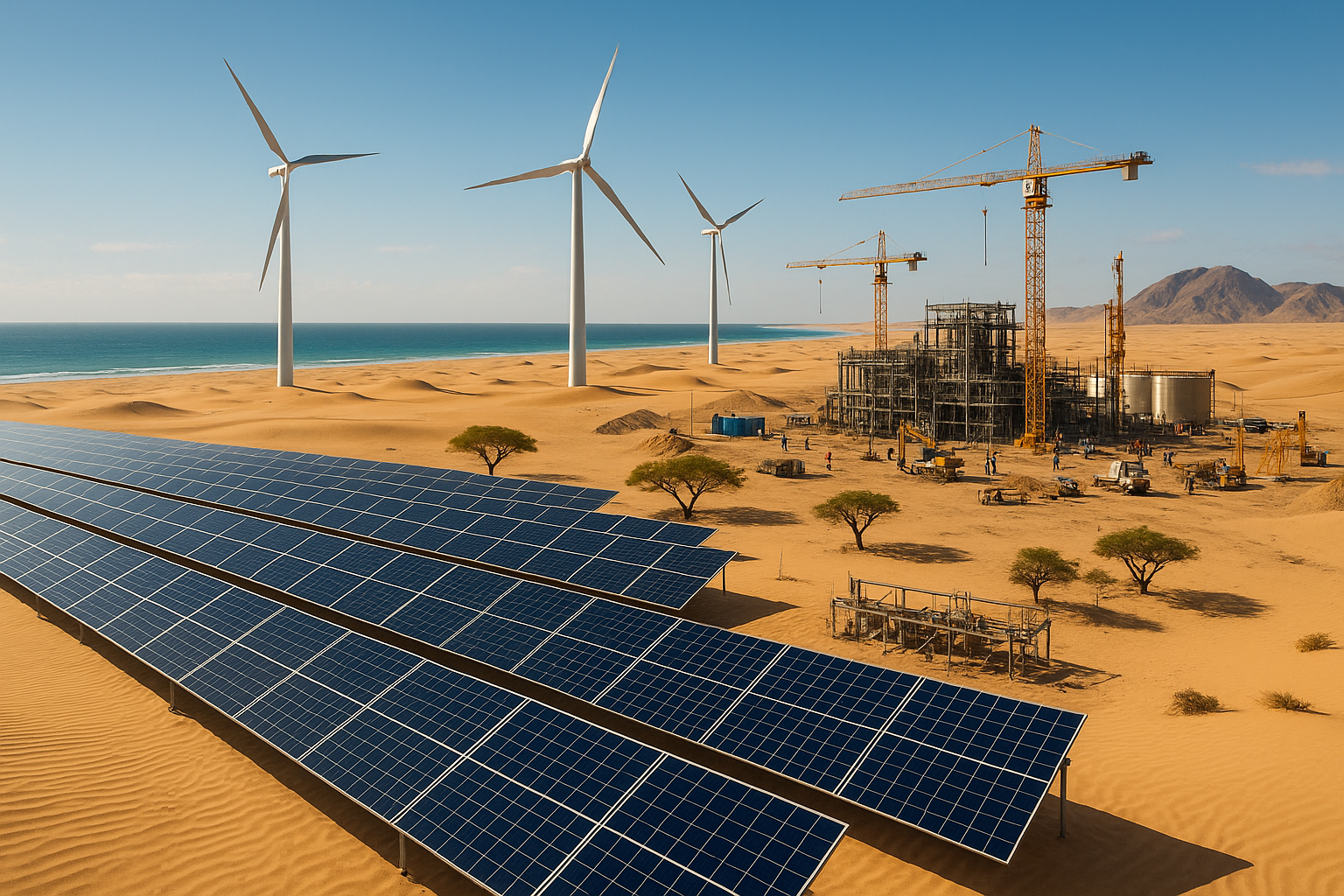

The Sun Belt of Tomorrow
How Africa Is Rewriting Europe's Energy Future
While Europe debates its energy transition, Namibia is building a $10 billion hydrogen empire in the desert. Germany is paying close attention.
By Christian Schappeit | Energy & Industrial Transformation
In the Tsau//Khaeb National Park, where the Namib Desert meets the Atlantic Ocean, something extraordinary is taking shape. This remote corner of southwestern Africa, once valued only for its diamond deposits and stark beauty, is about to become ground zero for one of the most ambitious energy projects the world has ever seen. And the primary customer? Germany.
The Hyphen Hydrogen Energy project isn't just another renewable energy venture. It's a $10 billion bet that Africa can fundamentally reshape how Europe powers its industries. By 2030, this single project aims to produce 2 million tonnes of green ammonia annually, shipping clean energy across the Atlantic in a form that doesn't require cryogenic temperatures or exotic infrastructure.
For Germany, this isn't philanthropy. It's survival.
The German Imperative
Germany's energy crisis didn't begin with the war in Ukraine. It began the moment the country realized that its industrial base, the engine of European manufacturing, cannot decarbonize using domestic renewable resources alone. The math simply doesn't work. Germany has limited sunshine, contested wind farm locations, and an industrial sector that consumes energy at a rate that dwarfs its ability to generate clean power locally.
Enter the National Hydrogen Strategy. Germany has committed to importing massive quantities of green hydrogen and its derivatives to power steel plants, chemical facilities, and heavy transport. But hydrogen is notoriously difficult to move. It's the smallest molecule in the universe, prone to leaking from virtually any container, and requires either extreme compression or cryogenic cooling to achieve practical energy density.
"Green ammonia carries 30% more hydrogen per cubic meter than liquid hydrogen itself."
The solution is elegant in its simplicity: don't ship hydrogen. Ship ammonia. Green ammonia, produced using renewable electricity, carries about 17-18% hydrogen by weight and can be transported using infrastructure that already exists. Ammonia tankers, storage facilities, and handling protocols have been refined over a century of fertilizer production. The molecule is toxic and requires careful handling, but it's a known quantity, not an engineering frontier.
Namibia's Moment
Namibia possesses something increasingly rare in the global energy transition: vast expanses of land with world-class solar and wind resources, political stability, established rule of law, and a government that understands the opportunity. The Tsau//Khaeb concession offers conditions that energy developers dream about: solar irradiation exceeding 2,000 kWh per square meter annually, consistent coastal winds, and proximity to deep-water ports.
The Hyphen project, led by German renewable energy company Enertrag as the controlling shareholder, represents the largest foreign direct investment in Namibian history. Phase 1, scheduled to begin construction in late 2026 following the final investment decision earlier that year, will deploy approximately 3.75 GW of renewable generation capacity and 1.5 GW of electrolyzer capacity. Phase 2 will double these figures by 2030.
But Namibia isn't just providing real estate. The country has explicitly classified this as an industrialization project, not a resource extraction exercise. The government has enacted policies banning the export of unprocessed critical minerals, including lithium and rare earths. A 2025 memorandum of understanding between the Namibia Green Hydrogen Programme, Broadmind Mining, and HyIron aims to integrate critical mineral processing with green hydrogen production, creating low-carbon steel and other value-added products domestically.
In March 2025, the HyIron Oshivela plant produced southern Africa's first green hydrogen using electrolyzers powered entirely by solar and battery storage. This wasn't a demonstration project. It was a statement of intent.
The Chemistry of Independence
The process chain connecting Namibian sunshine to German steel plants involves century-old chemistry deployed in entirely new ways. Water electrolysis, powered by renewable electricity, splits H₂O into hydrogen and oxygen. An air separation unit extracts nitrogen from the atmosphere. The Haber-Bosch process, essentially unchanged since its development in the early 1900s, combines these inputs at high temperature and pressure to produce ammonia: N₂ + 3H₂ → 2NH₃.
What makes this green isn't the chemistry. It's the energy source. Conventional ammonia production uses natural gas both as a hydrogen feedstock and as process heat, making it one of the most carbon-intensive industrial processes on Earth. Green ammonia replaces fossil inputs entirely.
At the destination, ammonia can be used directly as fuel for shipping or power generation, or "cracked" back into hydrogen and nitrogen. The cracking process requires significant energy input, reducing round-trip efficiency to roughly 25-35%, but the logistics advantages often outweigh these losses. The alternative, liquid organic hydrogen carriers (LOHCs), offers easier handling but lower hydrogen density and requires shipping the depleted carrier back to the source for reuse.
Strategic Stakes
Germany's Federal Minister for Economic Affairs and Climate Protection, Robert Habeck, has designated Hyphen as a "strategic foreign project," unlocking enhanced trade promotion tools, government guarantees, and potentially export credit support. German utilities including RWE have signed memoranda of understanding for off-take agreements. The bilateral German-Namibian hydrogen partnership, formalized through multiple government agreements, positions this relationship as a template for future energy diplomacy.
"This is not aid. This is industrial strategy with a 30-year horizon."
The historical irony is difficult to ignore. Namibia was a German colony until 1915, and the Herero and Nama genocide represents one of the darkest chapters in colonial history. Modern German engagement in Namibia operates in the shadow of this legacy, with some critics arguing that green hydrogen investments represent a new form of resource extraction. Proponents counter that the partnership's emphasis on local value creation, technology transfer, and Namibian equity participation distinguishes it from historical patterns.
The Broader Continental Shift
Namibia isn't alone. Morocco, Egypt, South Africa, and Mauritania are all developing green hydrogen strategies. The African Development Bank estimates that the continent could capture 10-15% of the global hydrogen market by 2050 if infrastructure investments materialize. The combination of abundant renewable resources, growing technical capacity, and proximity to European and Asian markets creates a structural advantage that no policy intervention can replicate elsewhere.
For Europe, this represents a fundamental shift in energy geography. The 20th century was defined by pipelines running east from Russia and south from North Africa, carrying fossil fuels to European consumers. The 21st century may be defined by shipping lanes running north from African ports, carrying energy in molecular form that produces nothing but water when consumed.
The regulatory framework is still catching up. Green ammonia as a hydrogen carrier is not classified as a dual-use substance under EU export control regimes, and anhydrous ammonia is not on the explosives precursors list. However, derivatives like ammonium nitrate face strict controls, and authorities may expand reporting and licensing requirements as trade volumes increase. For project developers, this means building compliance infrastructure now, before regulations tighten.
What Comes Next
The Hyphen project's final investment decision, expected in the first half of 2026, will mark the transition from aspiration to construction. The environmental and social impact assessment, currently in its second draft, addresses concerns about the project's location in a national park and its implications for local communities. These aren't trivial issues. They're the kinds of challenges that have derailed large infrastructure projects worldwide.
But the fundamental economics are compelling. Namibia offers renewable electricity at costs that European producers cannot match. Shipping ammonia is cheaper than building hydrogen pipelines across continents. And the industrial demand is real, driven by regulatory mandates and corporate decarbonization commitments that leave major emitters with few alternatives.
The question isn't whether Africa will play a significant role in the global hydrogen economy. The question is whether European policymakers and industrial leaders will move fast enough to secure their position in a supply chain that others are also racing to establish. China, Japan, and South Korea are all pursuing hydrogen partnerships across Africa and the Middle East. First-mover advantages in infrastructure, port facilities, and long-term supply agreements will compound over decades.
In the Namib Desert, the future is being built in steel, silicon, and electrochemistry. The continent that powered Europe's industrial revolution with human labor and extracted resources may soon power its green transition with sunshine and wind. The terms of that exchange will define whether this represents a new chapter or a repetition of old patterns.
For Germany, the stakes couldn't be clearer. Without access to imported green hydrogen and its derivatives, the country's industrial base faces an existential threat. With it, German manufacturers can maintain competitiveness while meeting climate commitments.
The sun is rising over Tsau//Khaeb. Europe should be paying attention.
___
This article is part of Food in the City Talk's coverage of industrial transformation and energy transition. For more analysis on how technology and policy are reshaping business landscapes, subscribe to the Food in the City Podcast.
.png)
%20(13).jpg)